Showing posts with label sunday roast. Show all posts

Monday, March 2, 2015

spice-crusted pork tenderloin

You all know of my deep and abiding love of all things pork, but I have been keeping a dirty little secret from you: I am not a fan of pork tenderloin. I love the texture of it, but similar to beef tenderloin, it has very little flavor in and of itself, and to a card-carrying meat lover, that's kind of sad-making. That, along with the fact that tenderloin is super lean and easy to over-cook have led me to just basically avoid buying it for many years.

Until this past weekend.
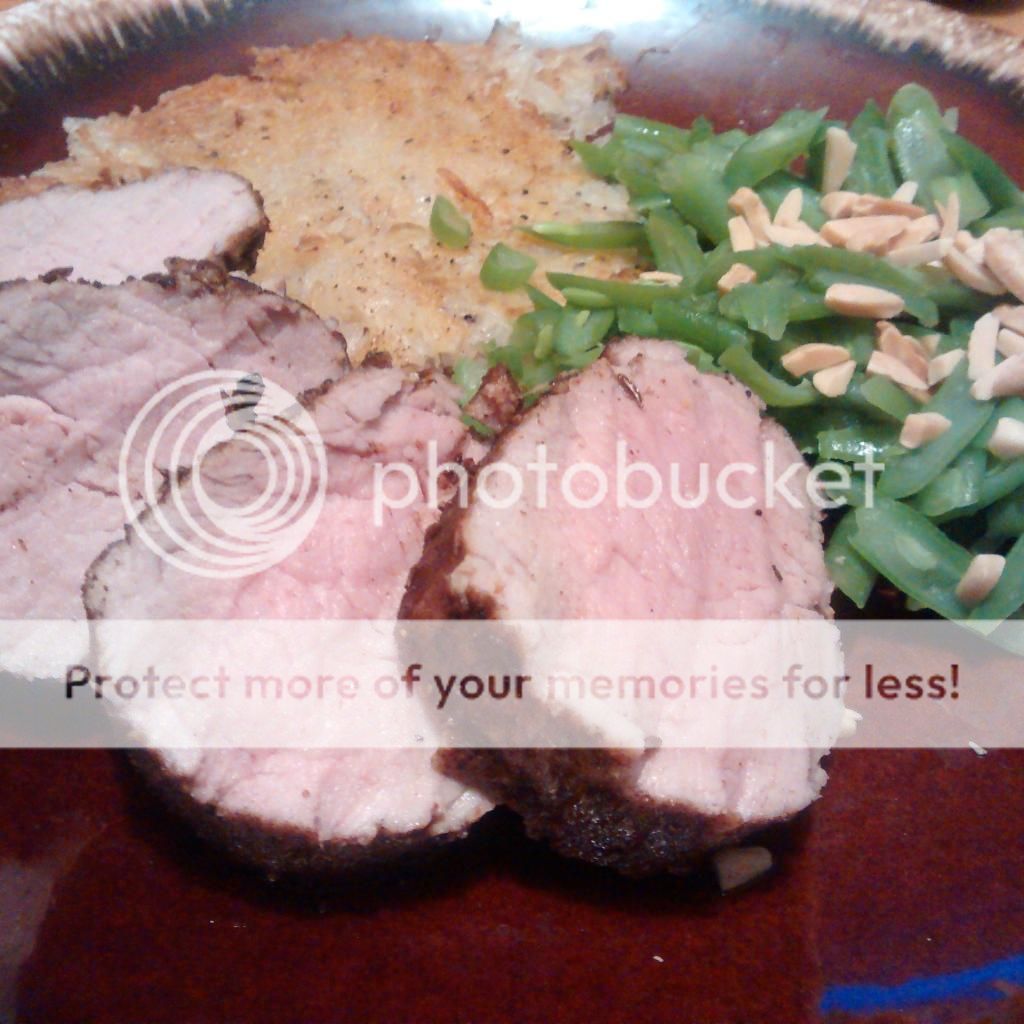
Sexy meat.
I found a recipe for spice-crusted pork tenderloin in a Cooks Illustrated collection of "skillet dinners". They showed medallions of rosy moist pork heavily crusted with spice and served with a sexy golden-brown potato roesti (which, for the unintiated, is basically a giant pan-fried hash brown and is one of the best things you can make with potatoes. Which is saying a lot, in my book, because I love me some potatoes). I was sold. I needed to try it. I tried to talk myself out of it, but it just wasn't working. The hook was firmly set and I surrendered to the pull.

The recipe calls for rolling the tenderloins in a mixture of spices (caraway seeds, ground coriander, nutmeg, allspice, salt and black pepper), then searing the meat off on all sides in a hot pan with a bit of melted butter. The meat then goes in a baking dish in a 425 degree oven for 12-15 minutes until it hits 140 degrees. You take the meat out at that point, tent it with foil, and let it rest until it hits 150. I ended up having to leave mine in the oven for about 22 minutes to get it to 140 degrees, but that was entirely my own fault because I didn't pull the meat out of the fridge until like 20 minutes before I wanted to cook, which is a rookie move.

Even with the added cooking time, the meat stayed super juicy and tender, though. And when I say tender, I mean like...you could cut it with the side of your fork. No knives necessary. Redonkulous. I think next time I make this, I'm going to pre-rub the meat (hurrrr) with the spice mixture and let it sit for a while before I cook it, just to see if the flavors sink in more. I suppose you could brine the tenderloin ahead of time if you were feeling really fucking ambitious about it, but a) I'm never that ambitious and b) I'd be a little worried that brining might turn the meat mushy rather than impart more flavor. I don't know. If you try it, tell me what you think.

The roesti was a little more work - I opted to shred my potatoes by hand rather than using my small and finicky food processor, so I got a good triceps workout holding the box grater at a weird angle in the bowl. You then have to rinse the excess starch off the shredded potato, then scoop it into a clean dish towel and wring as much water as you can out of it. You season the potato with salt and pepper, add a little corn starch to help bind the potato together better (there was a reason for this given in the write-up about the recipe but I was skimming so...yeah. No science today, sorry!), then plunk it all into a hot pan with some melted butter and keep squishing it down until it's a nice compact disc. It gets all GBD (golden brown delicious) on one side, then you flip it (which is a delicate operation, I tell you what), and let it get GBD on the other side. BOOM. Giant hash brown heaven. I will say, with regard to the roesti, that I should have had my heat turned up higher when I started, so it ended up kind of greasy. EVEN SO. Giant hash brown. So crunchy, much nom.


I steamed up some green beans with almonds to complete the plate. In retrospect, I could have made them more fancy with like some orange zest and cranberries, but...eh. I'm the weirdo who likes green beans even raw, so they don't need much fancying up for me to shove them in my nom-hole.

God, nom-hole sounds dirty. I'm keeping it. I love it. Heeeeee.

Anyway - this dinner is gloriously gluten-free (assuming you're doing your own due diligence on your spices). If you're going the Paleo or Primal route, you'd want to omit the corn starch and white potatoes, depending on how strict you're being.

Sunday, November 30, 2014

pork magic

Pork is my favorite meat. Shocker, I know. There's just something about pork, though. Something delicious. I could never be a vegetarian, because pork. Any other type of meat, I could easily do without - but take my pork away and I would be a sad panda indeed.

Last weekend I did a bone-in pork rib roast slow and low, and it turned out fantastic. I didn't take any pictures of it because I wasn't in a blogging mood (doing some work getting my brain-meats sorted out lately, hence the absence), but it was good enough that I was quite happy with the idea of a repeat performance today. When I found a blade-portion roast all ready to go AND on sale at the meat counter during my shopping trip, I did a little happy dance.

 I was thinking about doing some sort of cumin-crusted application with the pork, but one of the things I managed to forget whilst shopping was, in fact, cumin. Standing in front of my spice rack, I was starting to scheme about another rub to do when it hit me - I had a tub of ras el hanout, which is cumin-based, still sitting on the shelf from a previous spice-mixing venture. Hooray! I gave the roast a good rub of the spice mix, plus a little extra sprinkle of kosher salt, then popped it into a 250 degree oven. I checked the temperature after an hour, and down by the bone it was registering 90 degrees. Definitely not done, but that was to be expected. I bumped the oven up to 275 and left it for another 45 minutes. When I came back to check it again, it was reading at 140 by the bone. I pulled the roasted, tented it with foil, then let it rest for about 35 minutes while I roasted off the veg for my side.

When I went to carve the roast, I knew I was on to a winner. It was ridiculously tender, and the little rind of fat on top of the roast had crisped up beautifully. The rich, spicy, orange-y smell of the ras el hanout combined with pork fat was fabulous. Such a good combination!

Mmm, roasty.

The veggies on the side are a combination of roasted parsnips, Brussels sprouts, shallots, and a few carrots I had hanging around that I wanted to use up. The Brussels sprouts, for the record, were ENORMOUS. The largest one was almost as big as a lightbulb, and they were all bigger than an extra large egg. I was a little worried that they'd be bitter, but they weren't at all, which was a relief. I roasted the veg very simply - I just tossed them with salt, pepper and olive oil and spread them on a cookie sheet lined with parchment paper (makes a big difference in terms of things not sticking). They went into a 425 degree oven for 30 minutes, then I stirred them a little and put them back in for another five minutes or so just to brown a little more. If you've never had parsnips, this is the way to try them, seriously. I grew up in a non-parsnip household because my mom hates them, but I've grown quite fond of them since my husband talked me into cooking some for him a few years back. Roasted parsnips have a sweetness to them - their astringency melts away and they end up mellow, almost fruity tasting. The more brown, crisp and caramelized they get, the more delicious they are.

For anyone playing along at home, this dish is not only completely gluten-free, but also Paleo- and Whole30 compliant. 


Sunday, October 6, 2013

sunday roast: beef chuck NOT used as pot roast?!

I don't really like pot roast. There, I said it. I think pot roast is boring. I mean, it's ok once in a while, but pot roast is just not one of those things that I get a hankering for on the regular. Thus, when chuck roast inevitably go on sale at the grocery store about once a month, I spend a bunch of time trying to figure out what kind of non-pot-roast things I can do with it. Beef stew is an obvious choice, I've got a very good Texas-style chili recipe that uses chunks of chuck, and I've had great success with making beef enchiladas out of chuck.

Those three recipes all have one thing in common with pot roast: they cut the meat into chunks and braise it in liquid for ages. The General Internets would have you believe that braising is the ONLY good way to cook chuck, that if you try to roast it you'll just end up with a chunk of terrible grey shoe leather.

I am here to tell you that, in regards to chuck, the General Internets is wrong. You can dry-roast a piece of chuck in the oven and end up with delicious, rare slices of meaty awesomeness like this:

Gravy makes everything better.
There are a couple of tricks to this, though. First, you need to cook the beef "slow and low" - that's at a low temperature for a long time. The roast I did was about 3 lbs - I started it in a 450 degree oven for 10 minutes, then turned the temperature all the way down to 200 to cook for the next two hours. You could even turn the oven lower and let it cook longer, but my oven only goes down to 200 so I had to make due.

Second, flipping the roast halfway through will help make sure it gets cooked evenly. See how the bottom edge of my slices are just starting to turn a little grey? That's because I didn't flip the meat over after the initial 450 degree blast. That side of the roast got more heat for longer and started to over-cook a little bit. Probably if I hadn't been so lazy and I had seared the roast off in a frying pan first, I could have just put it directly into the low-temp oven and avoided the problem completely. I still would have needed to flip the roast halfway through, though.

Third, slicing thinly does wonders, especially if you can slice across the grain. Chuck tends to be hard to cut across the grain because it's a large, developed muscle. The muscle fibers run in several different directions depending on what part the roast is cut from. If your roast is shaped such that you CAN cut across the grain, it will make the end result that much more tender.

Lasty, gravy improves all things. For the gravy, I moved the roast to a plate and used a little beef stock to deglaze the cookie sheet I had baked the roast on. When all the brown goodness was scraped up, I added the accumulated juices from the plate where the roast was resting, dumped it all into a small sauce-pan, added some coarse-ground black pepper and let it reduce on low for about 15 minutes.


The result of all this yielded slices of meat that were fork-tender, succulent, and full of the big beefy flavor that chuck is known for. So, next time you find yourself with a big piece of chuck, a lot of time on your hands and want to branch out from the run-of-the-mill braise, give roasting a try instead!